
Cleveland
What Happens When the Cameras and Attention Goes Away
“I knew something was wrong when I saw a pretty little white girl jump into a black man’s arms.”
“Ain’t nobody got time for that.”
“Hide your wife, hide your kids, hide your husbands, cause they raping everybody out here.”
In the last couple of years these phrases have spread across the vast corners of the internet and into Hall-of-Fame of memes. They’re the words Charles Ramsey, Sweet Brown and Antoine Dodson.
 |
| Photo by Lucian Perkins of the Washington Post |
It’s worth noting that these weren’t just random people who happened to be standing around when they interviewed by an unsuspecting news team. They were all heroes to some degree. It can be easy to forget that once the auto-tune videos and memes began rolling out like rabid mice out of a cage.
Antoine Dodson had rescued his sister from an intruder. Sweet Brown rescued herself from a fire. And in the case of Charles Ramsey, he solved a mystery that had stumped the Cleveland police for more than a decade when he rescued three women who had been held captive in his neighbor’s home.
With each of these cases, all three heroes may not have been the most eloquent on camera, but come to think of it, should it have mattered? I’m not sure how I would feel if I made one slip-up in front of a camera and then people are selling my t-shirts with my face on it. While Dodson, Ramsey and Brown did gain quite a bit of notoriety for their 15 minutes of fame, I’m curious if their lives are substantially different a few years from now — long after the fame, attention and appearance fees are gone.
When Violence Goes Viral: The Social Repercussions of Standing By
Earlier this month, a man was pushed down a subway tunnel and could not be saved. But his snapshot was.
That event sparked not only every New Yorker’s most subconscious fear -standing too close to the edge of a platform and being pushed over- but also outrage for the lack of action taken to save a man fighting to get out of the path of an oncoming train. The most glaring outrage was directed at photographer R. Umar Abbasi, for taking a photo of the man just before he was struck by the train. The NY Post would publish the haunting photo the next day.
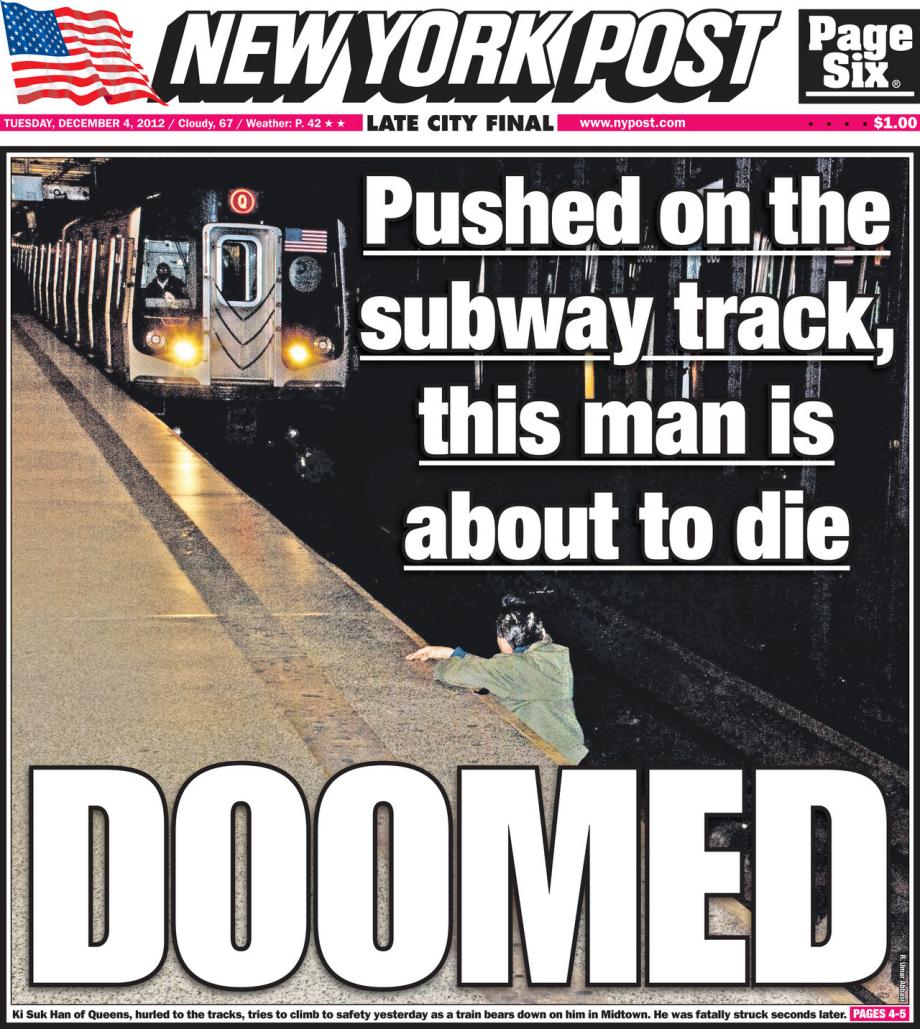
This isn’t the first instance of video or photos showing a person in danger.
In October, a video went viral of a Cleveland bus driver getting into an argument with a female passenger. The argument escalates and then the uppercut from hell is unleashed.
By videotaping this incident, it went from an outrageous event on a Cleveland bus, to leading newscasts, to trending on Twitter and in the process became one of 2012’s top web sensations. Police were called and the bus driver subsequently lost his job. Violence being filmed and recorded for the pleasure and delight of others is not just limited to Cleveland however.
In January 2011, Allen Haywood was waiting for his train at a metro station in Washington, D.C. As the video shows, two kids come from out of nowhere and begin pummeling the man. Haywood is understandably stunned as to why he is being attacked. He even screams at the girl who is attacking him: “I have done nothing to you!”
Even sadder is the fact there appears to be a group of kids in the background just laughing while filming the incident on their cell phones. Haywood says none of the kids came to his assistance, nobody called for help and that other people on the platform did nothing. A few days later, Haywood returned to that same metro station and held up a sign saying, “I WAS ATTACKED AT L’ENFANT METRO SUNDAY AT 7:15 PM. NO ONE HELPED. PLEASE BE CAREFUL.”
All of these cases leave one wondering when did we become a society more concerned about capturing the next punch or assault on video, as opposed to actually putting down the cell phone and doing something about it? What moral and ethical questions are there as bystanders in these situations? It is one thing to not want to get involved in an altercation for fear you yourself might get injured. It is entirely different however, to do nothing at all. Things to think about…
 FilmSwag