James Earl Jones On Overcoming Obstacles

I feel no flattery when people speak of my voice. I’m simply grateful that I found a way to work around my impairment. Once a stutterer, always a stutterer. If I get any credit for the way I sound, I accept it in the name of those of us who are impaired.”

                                                                                     – James Earl Jones, 1993

From Playbill.com

Remembering Komla Dumor

It’s not often that the passing of a journalist elicits mourning among people across two continents, but the reaction to Komla Dumor’s death speaks to the impact he had not just in the news industry, but on the people he covered as well.

From NPR.org

Komla Dumor passed away last month due to a heart attack. At the time of his death he had been the Africa business reporter for BBC Television in London, where he had worked since moving from Ghana in 2006. It was in Ghana that Komla won the 2003 Journalist of the Year Award.

It wasn’t exactly reasonable to expect one man to cover an entire continent, but Komla did about as good of a job as humanly possible when discussing Africa. As a son of the continent, he brought a perspective and reach that many in the news industry simply would not have been able to replicate. Below is a speech he gave at the Ted x Euston conference in 2012 on the importance of telling the encompassing African story when reporting. Komla was 41-years-old at the time of his death.

  http://www.npr.org/v2/?i=264873737&m=264873738&t=audio

Source: BBC

Richard’s Rant Heard Roun’ The World

Richard Sherman sure was hyped following the NFC Championship Game last weekend. The post rant fallout hasn’t been nearly as fun however.

In the last couple of years the loquacious cornerback, Sherman, has gained a bit of a reputation for getting in to people’s faces and not being afraid to make a point. He did it to Tom Brady. He did it to offensive tackle Trent Williams and received a parting shot by way of a right hook. Neither of these two previous episodes received the attention of Sherman’s latest post game faux pas.

Here’s the video for those who might have missed it.

As you can see, Sherman is clearly excited and maybe just a tad vindictive towards 49ers wide receiver Michael Crabtree. The reporter, Erin Andrews, is clearly caught off guard.

I must admit when I first saw the interview as it was happening, my first thought was, “This guy sure is mad.” Then I thought about it more and remembered this man literally just made the game saving play against a guy who he feels slighted him in the past. Oh, and that play is one of the key reasons why the Seahawks are going to their second Super Bowl in the last 8 years.

In the days following the interview, the condemnation was swift.There were those who said Sherman was classless, a poor example of sportsmanship, and showed firsthand what not to do in a post-game interview. There were also those that used code words like ‘thug’ to describe Sherman’s antics. Some on social media even went as far as to refer to Sherman as a monkey.

Clearly, Sherman probably could have handled the post-game interview better, and he has since admitted as much. However, I think we have to remember that he was interviewed moments after he made the biggest play in the game, at home, and that he sealed his team’s trip to the Super Bowl in New Jersey (yes, New Jersey).

So to not expect him to be hyped and animated isn’t exactly fair. We want our athletes to be motivated, animated, and using whatever slights against them (real or imagined) to up their game even more to perform at the highest level. You can’t expect guys to be making tackles, taking hits, putting hats on people, and then get mad when they may not show the best decorum in a post-game interview. I have no problem with people who criticized Sherman’s rant for him going after Crabtree. But calling a man a thug (this so called thug also happens to be a Stanford grad) just based off nothing more than his appearance and an interview, reveals a lot more about some of Sherman’s critics than it does Sherman. Stay classy, folks.

When A Role Overtakes an Actor

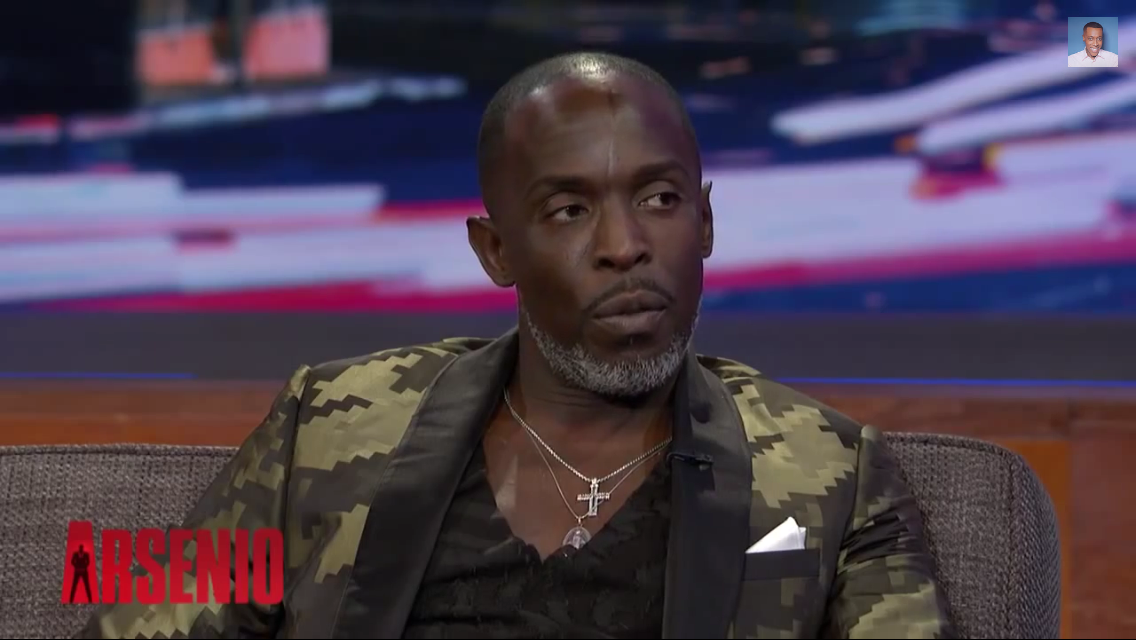
If anyone ever wondered whether certain roles can wear on an actor, they can look no further than this clip featuring actor Michael K. Williams.

In a recent appearance on the Arsenio Hall Show, Williams, who had a small part in the film “12 Years A Slave,” speaks on a particularly emotional scene that was not shown in theaters. In it, Williams describes being dragged on a slave ship, and after reenacting the painful event a few times, how he breaks down screaming and crying. Take a look.

I witnessed a similar event while on a film set a few years ago.

In the Summer of 2011, I was a production assistant on an independent feature film. The basic premise of the film centered on two men, one who was a terrorist, the other a college professor. In one scene, the actor who played the terrorist, kidnaps the professor and is raging mad as he is driving a cab. As we were filming the scene and re-shooting it, the actor playing the terrorist broke down at the end of the scene and began crying. Some of the crew consoled him. It was clear he had been overcome with emotion.

Intense roles like these are not easy to watch — let alone perform. Roles that involve scenes in which anger, brutality, and violence are portrayed, can often be physically and emotionally draining. That’s often when we see some of the the greatest acting performances as well. When I think people hear acting, many often associate it with ‘pretending.’ He’s pretending to be that secret agent. She’s pretending to be that ailing mother. They’re pretending to be small town citizens in a 1950s crime drama. The difference however is that acting is not so much pretending as it is becoming that person or thing while the cameras are rolling.

It’s a subtle difference that can make a good acting job be looked at as Oscar worthy. It’s why actors spend so much time researching a historical figure and spending time with those who knew them; or reading articles about an event and visiting that place where such events happened. As we’ve seen though, it’s not always easy to become someone and assume the emotional baggage that comes with that role.

Remembering Juanita Moore

Photo by the AP

In 1960 Juanita Moore would become only the third African American to earn an Academy Award nomination. That would be the highlight of her career.

Juanita Moore was born in Mississippi in 1914 and passed away on January 1st of this year. She worked her way up from nightclub dancer, to background actress, to earning an Academy Award nomination for her role in the 1959 film “Imitation of Life.”

Following the nomination, work was not necessarily any easier to come by. Moore remarked that she actually got more jobs before the Oscar nomination because now casting directors couldn’t see her taking on any more maid/servant roles. It was an uncomfortable plight similar to what Dorothy Dandridge experienced.

In the years after her Oscar nod, Juanita Moore would continue to work in television and on Broadway. She was 99-years-old.

Harry Belafonte on Race & Cinema

This is from a speech made by the legendary artist Harry Belafonte at the New York Film Critics Circle Awards last week.

The power of cinema is an uncontainable thing and it’s truly remarkable, in its capacity for emotional evolution. When I was first watching the world of cinema, there was a film that stunned the world, with all its aspects and art form. They did a lot, at that time. The film was done by D.W. Griffith, and it was called The Birth of a Nation, and it talked about America’s story, its identity, and its place in the universe of nations. And that film depicted the struggles of this country with passion and power and great human abuse. Its depiction of black people was carried with great cruelty. And the power of cinema styled this nation, after the release of the film, to riot and to pillage and to burn and to murder black citizens. The power of film.

At the age of five, in 1932, I had the great thrill of going to the cinema. It was a great relief for those of us who were born into poverty, a way we tried to get away from the misery. One of the films they made for us, the first film I saw, was Tarzan of the Apes. [Ed note: The movie is called Tarzan the Ape Man.] In that film, [we] looked to see the human beauty of Johnny Weissmuller swinging through the trees, jump off, and there spring to life, while the rest were depicted as grossly subhuman, who were ignorant, who did not know their way around the elements, living in forests with wild animals. Not until Johnny Weissmuller stepped into a scene did we know who we were, according to cinema.
Throughout the rest of my life … on my birth certificate, it said “colored.” Not long after that, I became “Negro.” Not too long after that, I became “black.” Most recently, I am now “African-American.” I spent the better part of almost a century just in search of, seeking, “Who am I? What am I? What am I to be called? What do I say? Who do I appeal to? Who should I be cautious of?” In this life, when we walk into the world of cinema, we use the instrument that is our ability to try to give another impression of who and what we were as a people, and what we meant to this great nation called America. I’m glad that Sidney Poitier should step into this space right after the Second World War, and new images of what we are as people, certainly as men.

A lot’s gone on with Hollywood. A lot could be said about it. But at this moment, I think what is redeeming, what is transformative, is the fact that a genius, an artist, is of African descent, although he’s not from America, he is of America, and he is of that America which is part of his own heritage; [he] made a film called 12 Years a Slave, which is stunning in the most emperial way. So it’s a stage that enters a charge made byThe Birth of a Nation, that we were not a people, we were evil, rapists, abusers, absent of intelligence, absent of soul, heart, inside. In this film,12 Years a Slave, Steve steps in and shows us, in an overt way, that the depth and power of cinema is there for now the world to see us in another way. I was five when I saw Tarzan of the Apes, and the one thing I never wanted to be, after seeing that film, was an African. I didn’t want to be associated with anybody that could have been depicted as so useless and meaningless. And yet, life in New York led me to other horizons, other experiences. And now I can say, in my 87th year of life, that I am joyed, I am overjoyed, that I should have lived long enough to see Steve McQueen step into this space and for the first time in the history of cinema, give us a work, a film, that touches the depths of who we are as a people, touches the depths of what America is as a country, and gives us a sense of understanding more deeply what our past has been, how glorious our future will be, and could be.
I think that the Circle Award made a wise decision picking you as the director of the year. I think we look forward in anticipation to what you do in the future. But even if you never do anything else, many in your tribe, many in the world, are deeply grateful of the time and genius it took to show us a way that it should be. Forever and eternally grateful to say that we are of African descent. Thank you.
– Text provided by Vulture