Thinking Like A Man and Walking Away With A King’s Ransom

I was definitely surprised to know that the film “Think Like A Man” was the leading movie at the box office these past two weeks (until “The Avengers” came in like an avalanche). The Steve Harvey inspired, Will Packer produced flick, I’m sure has exceeded expectations of the studio heads, but what does this mean for future films with predominantly black casts?

I raise this question because often times there is not the same amount of marketing dollars put into films with casts of color as there are with films with white leads. Case in point, when “Think Like A Man” was released, that same weekend, “The Lucky One” with teenage heartthrob Zac Efron, also hit theaters. “Lucky” made $22.5 million in its opening weekend while being released on more than 3100 screens nationwide. As for “Think Like A Man?” It would go on to make more than $33 million, opening in roughly 2100 theaters across America.

So let’s review the facts. “Think Like a Man” made more than $10 million more than Efron’s “The Lucky One,” despite being shown in a thousand less theaters nationwide. Quite an achievement one might say.

What this proves is that there is indeed a market for ‘black’ films, if these revenue numbers are any indication. What also helped was the fact that “Man” was marketed a full two months before its release date. Whether it was commercials during the NBA All-Star Game or constant references to check out the film’s various social media sites (a must these days), “Man” got the wheels in motion for building up intrigue well in advance. For a more in depth view behind the marketing push campaign for “Think Like A Man,” check out this interview with producer William Packer on the Shadowandact blog here.

Let’s see if Hollywood takes notice of this –or hell– other filmmakers maybe take notice of this success and get inspired to have their films reach wide audiences.

Scandalously Addicting

Kerry Washington is bringing style and substance in a new ABC drama that’s redefining the faces we see on television.

In her new hit TV show “Scandal,” Washington plays lawyer/crisis management strategist Olivia Pope. Pope is inspired by the real-life career of Washington insider Judy Smith. Smith played a key role in providing feedback and guidance for the Shonda Rhimes led series.

From the first few episodes I’ve seen so far, “Scandal” comes off as sharp, slick and leaving the viewer wanting more. You really feel like your one of the “gladiators in suits,” as the show takes you through an unfolding crisis as Pope and her team work to prevent it from becoming a full blown public relations nightmare.

What is also interesting about this show is that black women are at the front and center of it. The creator is a black woman, the lead actress is a black woman, and the show’s inspiration comes from a black woman. In fact, Washington is the first black women to star in a drama on network television in more than 30 years. Considering the fact that we’ve had an African-American First Lady for the last three years, it seems about time that women of color get more leading roles on TV.

Telling It Like It Is for More Than 40 Years

It was very sad news to hear last week that the man of the only afro-centric news show on network television, had passed away. Gil Noble had died of a stoke. He was 80-years-old.

Gil Noble is perhaps most well known for his 1-hour long television show “Like It Is,” which aired locally on channel ABC 7 here in the New York area.

Noble was one the first of what would be a new wave of black journalists hired by major news organizations when he was hired by ABC in 1967. It was a tenuous time in America. Malcolm X had been killed just two years earlier, the Vietnam War was in full swing, riots were breaking out across the country and in just a matter of months, Martin Luther King would be assassinated on a balcony in Memphis. Times were changing, and so to were newsrooms.

Up until the mid 60s, many newsrooms (and TV studios) were essentially lilly white institutions. Few people of color were covering these rapidly changing times of the late 60s and that was a problem. Credit Ed Silverman, who was the director of public affairs at Ch. 7 and who eventually hired Gil Noble, for saying as much in this excerpt to the Daily News:

“We decided to get off our assess and hire some African-Americans. TV news was lily white then. There were no black faces.”

Soon after, Noble was hired and by 1968 had his own show, “Like It Is.” Noble interviewed diplomats, world leaders, religious figures, civil rights leaders, as well as those in and around the NY area who were prominent people in the news at that time, such as the wife of Sean Bell in 2007.

How rare was the position that Gil Noble held? I can’t think of another person of color who wrote, produced and headlined their own news show on network television. Not one. Considering blacks make up just under 5% of all employees in newsrooms in America, that is a stunning development.

In the late 80s when my mother was pregnant with me and still living in Brooklyn, she ran into Gil Noble on the street. Mr. Noble asked the name of her son to be. She remarked, “Warin. Warin for warrior.” He replied, “Make sure he lives up to such a name.” Rest In Peace, brother Gil.

6 Months

Last Monday, March 26, was a special day on two fronts. Not only was it my birthday, but it was also the 6 month anniversary of this very site. Much love and appreciation to all of you who have read the articles and let me know your thoughts of them. I definitely appreciate the support. Also, big shoutout to my international readers as well. Especially those of you in Russia, Germany, and the United Kingdom. It is amazing and humbling to know that people from all over the world are reading your work. I have a lot more articles and video content to post in the coming months and look forward to sharing it with all of you. Let’s keep getting educated together. Peace.

Trayvon Martin & The Black Boogeyman

“It’s not our differences that divide us. It is our inability to recognize, accept, and celebrate those differences.” 

–  Audrey Lorde

Last Wednesday I attended the march for Trayvon Martin at Union Square in New York City. I was commuting from Brooklyn and didn’t make it till well after it had already began. Even still, there were a few hundred people in the park with signs, letters, and faces of concern at what happened nearly a month ago. The case of Trayvon Martin is troubling at best, and as a black man, downright frighting at its worst.


Though there are different variations and interpretations going around, here’s what we know so far.

  • On the night of February 26, Trayvon Martin is leaving the The Retreat at Twin Lakes development when he is pursued by George Zimmeran
  • Zimmerman follows Trayvon in his car despite being told by a 911 operator, “We don’t need you to do that.” 
  • All the while, Trayvon is on the phone with his girlfriend who tells him to run.
  • A struggle ensues between Zimmerman and Trayvon, and Trayvon is shot dead.
  • Zimmerman was armed with a 9 millimeter handgun. Trayvon? A bag of Skittles and an Arizona Ice Tea.

I can’t even begin to imagine the heartache Trayvon’s family is going through. Your son goes out in a gated community and the next thing you know he’s dead and the man who shot him hasn’t even been arrested.

Multiple reports have Zimmerman describing this guy as suspicious and out of place in the neighborhood. According to Zimmerman’s own words, he believes Trayvon is possibly on drugs at the time. As it turns out, Zimmerman probably should have been the one tested for drugs in light of his alleged reckless behavior.
What this most recent case of violence against another unarmed black man dictates is that black males are still subject to the criminal element stereotype. His jeans are too baggy. He’s looking at me suspiciously. What’s he got hiding in his waistband? It’s as if after all these years, there’s still this “boogeyman” element that too many black men have to contend with regardless of whether we fit the description or not.
In 1994, Time magazine infamously darkened O.J. Simpsons photo in attempt to make him appear more menacing. Time of course denied this, but folded to public pressure and issued a new cover. Here’s the original Time cover compared to Newsweek’s version. 


Regardless of whether or not you think O.J. was guilty, I can’t recall any white suspects having their photo altered in such a way to make them appear more threatening and evil. Images hold power. And the darkened photo of an accused black man certainly has the intended effect of making the accused appear more sinister. 
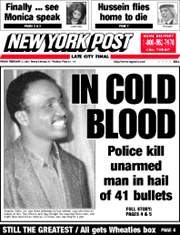
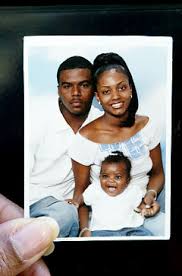
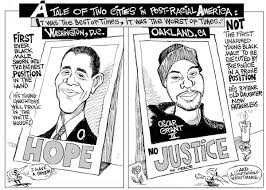
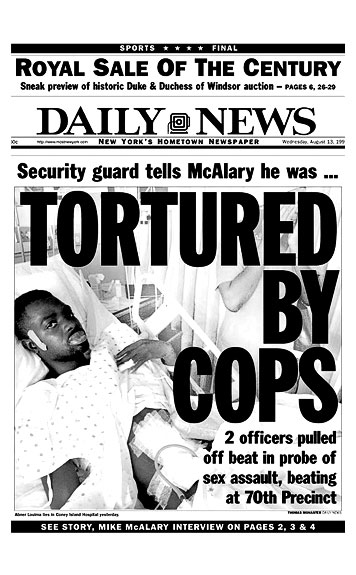
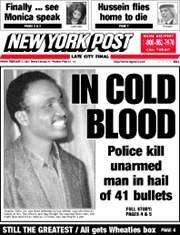
The idea of black men being deemed “suspicious” or perceived as some “boogeyman” continues to play out despite a stream of statements from police, law officials, and those within local government, to the contrary. It’s always, “we’ll do better.” “This won’t happen again.” “This should have never have happened.” So how many incidents like these have to keep happening before black men and people of color are no longer deemed “suspicious” because of their skin tone or article of clothing? Trayvon Martin is just another mark on the wall of a long list of black men who did nothing wrong, but either ended up dead or severely injured by the very people who were supposed to protect them.
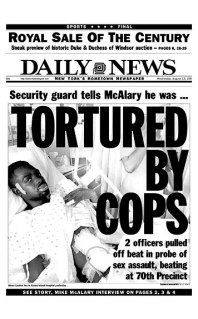
                     
Abner Louima, 1997
Amadou Diallo, 1999
Sean Bell, 2006

Oscar Grant, 2009

As you can see through the series of photographs, Trayvon Martin’s story is neither a new one, nor sadly, is his death. Many black men will have some form of interaction with the police in their lifetime. Whether it’s driving a car that is a little too nice, or living in a home that couldn’t possibly be yours, it’s clear that black men still have to prove themselves as legit even when it comes to their own possessions. 
This reminds me of my own interaction with the police. In 2010 I was pulled over by an unmarked cop car while riding a bike (yes, not a car, but a bike). According to the officers, I was riding “awfully quickly through an area with known drug activity.” I showed them my I.D. and they got back in their unmarked car and smiled at me. This is the BS that black men have to sometimes go through with law enforcement. 
It is because of all this that I felt moved to be at Union Square last week. Seeing people of many races and backgrounds showed at least that Trayvon Martin’s murder and subsequent investigation will not go quietly into the night. People protested. They sang. They marched. That night I spoke with a white woman from Colorado who said she was so moved by this case and sense of injustice, that she just had to be there. 
Hopefully, justice will come for Trayvon. But more importantly, hopefully in this land where a black man is the current Head of State, there will come a time when brandishing a hoodie and pack of Skittles, no longer deems you “suspicious.” Hopefully, that teen on the corner is no longer viewed as a potential “boogeyman,” but as a young man on his way home with a hoodie on his head and without any fear in his heart.  

Happy Birthday to the Queen

Queen Latifah is probably recognized more these days for her films than her rap career, but her music continues to leave an impact almost 20 years later.

Some of Latifah’s more notable film roles occurred with movies such as: “Brown Sugar,” “Valentines Day,” “Barbershop 2,” and 2010’s “Just Wright;” in which she starred opposite rapper, Common. Much like how Ice Cube, Will Smith, and LL Cool J made the transition from music to film, so did Latifah.

Being that this is Women’s History Month (and today happens to be Queen Latifah’s birthday), I think it’s fitting that we revisit Queen Latifah’s earlier days when she was just one of a handful of female MCs by way of Newark, New Jersey. Her single, “U.N.I.T.Y.,” which was released in early 1994, spoke out about the derogatory names and mistreatment of women in society. It’s message continues to speak volumes even today.